MACS Matchmaker
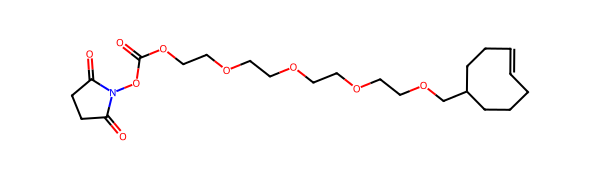
For direct, covalent immobilization on a [Me-Tz|PEG] or [Me-Tz|Tz] sensor, the ligand has to carry a TCO group. This page describes the off-chip activation route: a bifunctional NHS–PEG–TCO linker reacts with the ligand's primary amines (N-terminal or lysine side-chains), leaving a TCO handle on the ligand that then clicks onto surface tetrazines via inverse-electron-demand Diels–Alder (IEDDA). The product is a covalent, oriented-once TCO-tagged ligand ready for flow injection.
Before you start
- Read Safety & Compliance and the safety data sheet for every reagent below. The SDS, not this page, governs how a reagent is handled, stored and disposed of.
- Use the personal protective equipment and the waste route your laboratory prescribes for these reagent classes.
- Check this protocol against the materials actually in hand: confirm the intended Seq ID, the product revision, the lot-specific certificate and the instructions supplied with it. Where those differ from this page, the documentation supplied with the material governs.
Strategy
A bifunctional NHS–PEG–TCO linker is reacted with the ligand at a controlled molar ratio. The NHS end couples to a surface lysine (or the N-terminus); the TCO end is left exposed as a click handle. After removing free / hydrolyzed linker on a small desalting column, the TCO-tagged ligand is injected onto a Me-Tz sensor and clicks onto the ridges in seconds.
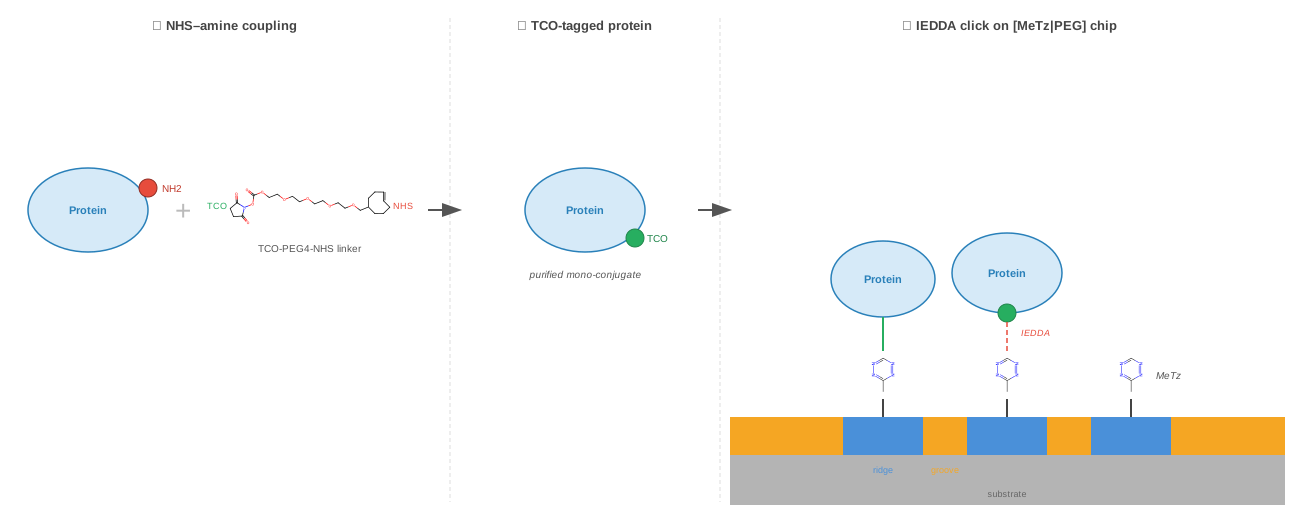
Linker chemistry choice
Three amine-reactive ester chemistries are commonly available for PEG–TCO linkers. The trade-off is between aqueous stability and commercial availability:
| Active group | Structure | Aqueous stability | Solubility | Notes |
|---|---|---|---|---|
| NHS | 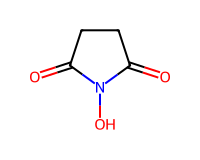 | Hydrolyses fastest | Good | Most widely available — the practical default. Use freshly prepared semi-stock and add immediately. |
| TFP | 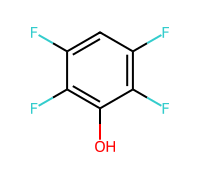 | Stable | Lower | Higher coupling yield than NHS; lower solubility can make downstream purification trickier. |
| STP | 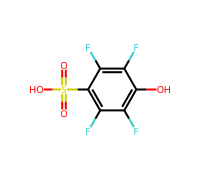 | Most stable | Good | Best control but PEGylated TCO–STP variants are not consistently in catalogue. |
The protocol below assumes the most accessible variant, TCO–PEG4–NHS (100 mM stock in anhydrous DMSO).
Protocol
Step 1 — Buffer exchange (amine-free buffer)
NHS chemistry requires the absence of competing amines. If the ligand is in Tris, glycine, histidine, or any other amine-bearing buffer, exchange into PBS-T (pH 7.4) using a 10 K Amicon spin column (3 K for ligands < 20 kDa). Four wash cycles at 14,100 × g for 10 min each are usually enough; a final wash in PBS-T pH 8.0 prepares the sample for the activation step.
Step 2 — Confirm the ligand concentration
Measure the ligand concentration on a NanoDrop (or equivalent UV A280) blanking against PBS-T pH 8.0. Take the median of three readings. Convert to molarity using the ligand's molecular weight — the linker stoichiometry depends on it.
Step 3 — Activation reaction (1:2 ligand:linker)
| Parameter | Value |
|---|---|
| Linker | TCO–PEG4–NHS, 100 mM stock in anhydrous DMSO |
| Molar ratio | 1 : 2 (ligand : linker) |
| Buffer | PBS-T pH 8.0 |
| Reaction | 25 °C, 1 h, 500 rpm orbital shaking |
| Working semi-stock | Dilute 2 µL of 100 mM TCO–PEG4–NHS in PBS-T pH 8.0 to give the volume calculated for your ligand amount; add the 2 µL semi-stock immediately to the ligand and mix vigorously. |
Step 4 — Remove free linker (Zeba 7K, two passes)
Pass the activated ligand twice through fresh Zeba 7K spin desalting columns (300 µL PBS-T pH 7.4 wash steps; load 120 µL sample; spin 1,500 × g, 2 min). Two passes consistently remove > 95 % of free linker / hydrolysis products. The first column pass also brings the ligand into pH 7.4, the storage buffer.
Step 5 — Final concentration and aliquoting
Re-measure the concentration on the NanoDrop (blanked against PBS-T pH 7.4). Aliquot the activated ligand at the highest concentration possible, snap-freeze, and store at −20 °C. Avoid freeze–thaw cycles. Typical aliquot sizes are 0.2–0.5 nmol per tube for Tz-sensor use, 1.0–1.5 nmol for Me-Tz-sensor use.
Reference protocol parameters
| Parameter | Reference value |
|---|---|
| Linker | TCO–PEG4–NHS |
| Linker stock | 100 mM in anhydrous DMSO |
| Activation buffer | PBS-T pH 8.0 (amine-free) |
| Ligand : linker ratio | 1 : 2 mol |
| Reaction | 25 °C, 1 h, 500 rpm |
| Purification | Zeba 7K desalting × 2 (PBS-T pH 7.4) |
| Storage | −20 °C, single-use aliquots, no freeze–thaw |
| On-chip injection | ≥ 10 µM on [Me-Tz|PEG] and [Me-Tz|Tz], ≥ 1 µM on the planned [Tz|PEG]; copper-free, seconds to minutes |
QC and acceptance
The activation either installed a TCO handle on the ligand or it did not. An un-activated ligand produces no covalent capture downstream — though not necessarily a flat trace, since it can still adsorb non-specifically — so confirm the activation rather than inferring it from the measurement.
- Amine-free buffer first. The NHS ester reacts with any primary amine, so Tris, glycine and other amine-containing buffers consume the linker before it reaches the ligand. Confirm the buffer exchange happened — a residual amine carried into the reaction is the most common reason for no activation at all, and it leaves no trace in the product except its absence.
- Activation succeeded. The added PEG–TCO mass is visible by intact-mass LC-MS or MALDI as a shift, resolved into linkers per molecule where the ligand allows it.
- Functional confirmation. Where mass spectrometry is not available, inject the activated ligand onto a Me-Tz sensor: it clicks and the response persists through the wash, while the same ligand taken through the protocol without linker does not.
No validated linkers-per-molecule target applies across ligands. Over- activation costs activity and under-activation costs coverage, so the usable range is established per ligand.
Practical notes
Once activated, inject the TCO-tagged ligand onto a [Me-Tz|PEG] (clean-buffer) or [Me-Tz|Tz] (matrix-tolerant) sensor. The chip is single-use per ligand — covalent capture is irreversible. For the full chip-and-adapter context, return to the interactive decision tree — the direct TCO–tetrazine click branch lands here.